A sketch-and-voice canvas for AI
Prep it. Serve it.
Let the AI cook.
Draw it, explain it, send it to AI. Preppit keeps every note attached to the thing it's about — so the AI is told what you mean, instead of made to guess from a screenshot with three paragraphs typed underneath.
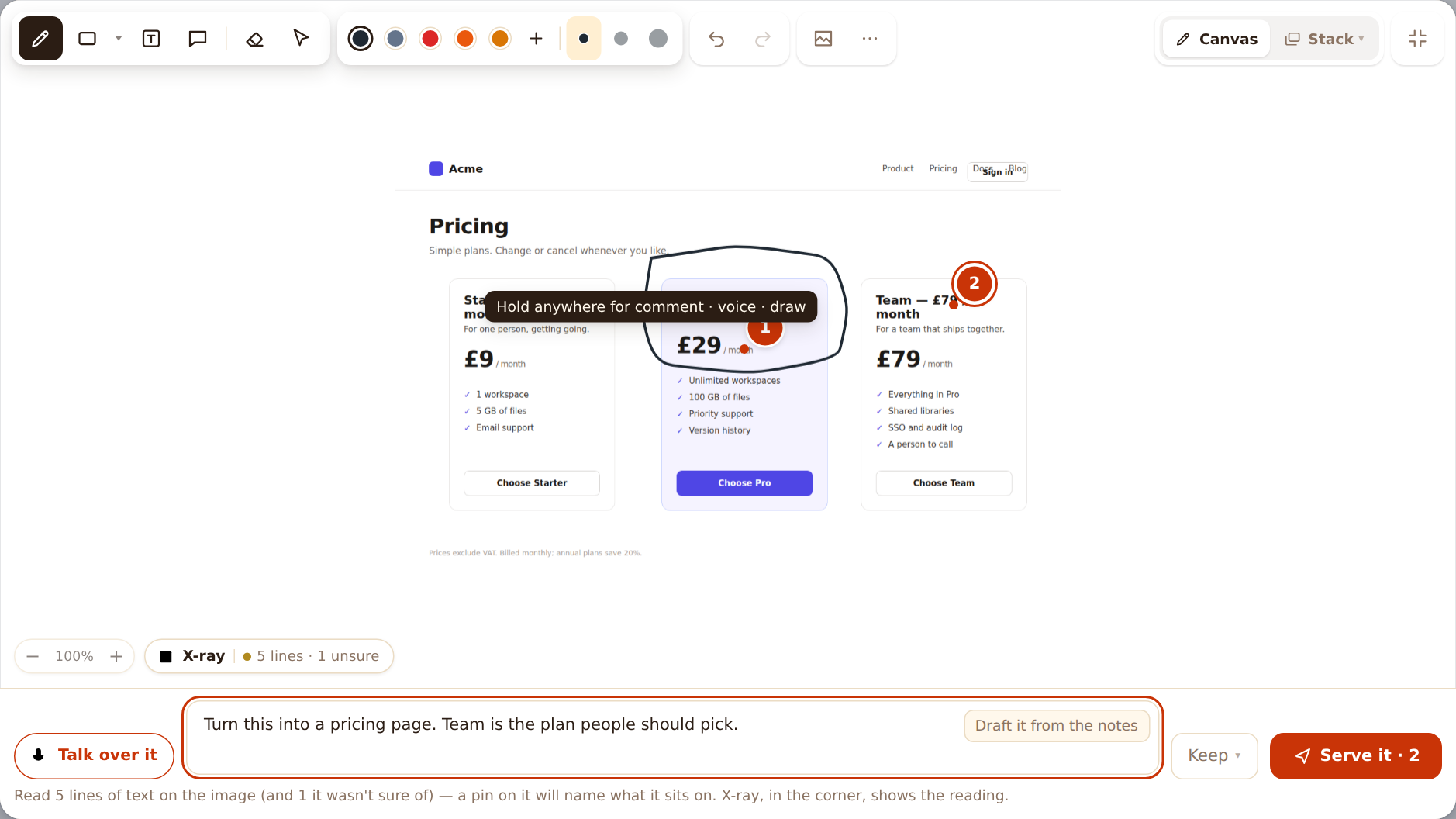
Pins that stay put
Press and hold anywhere to pin a typed note or a voice note to a spot, an object or a region. The note travels with what it's about, not just near it.
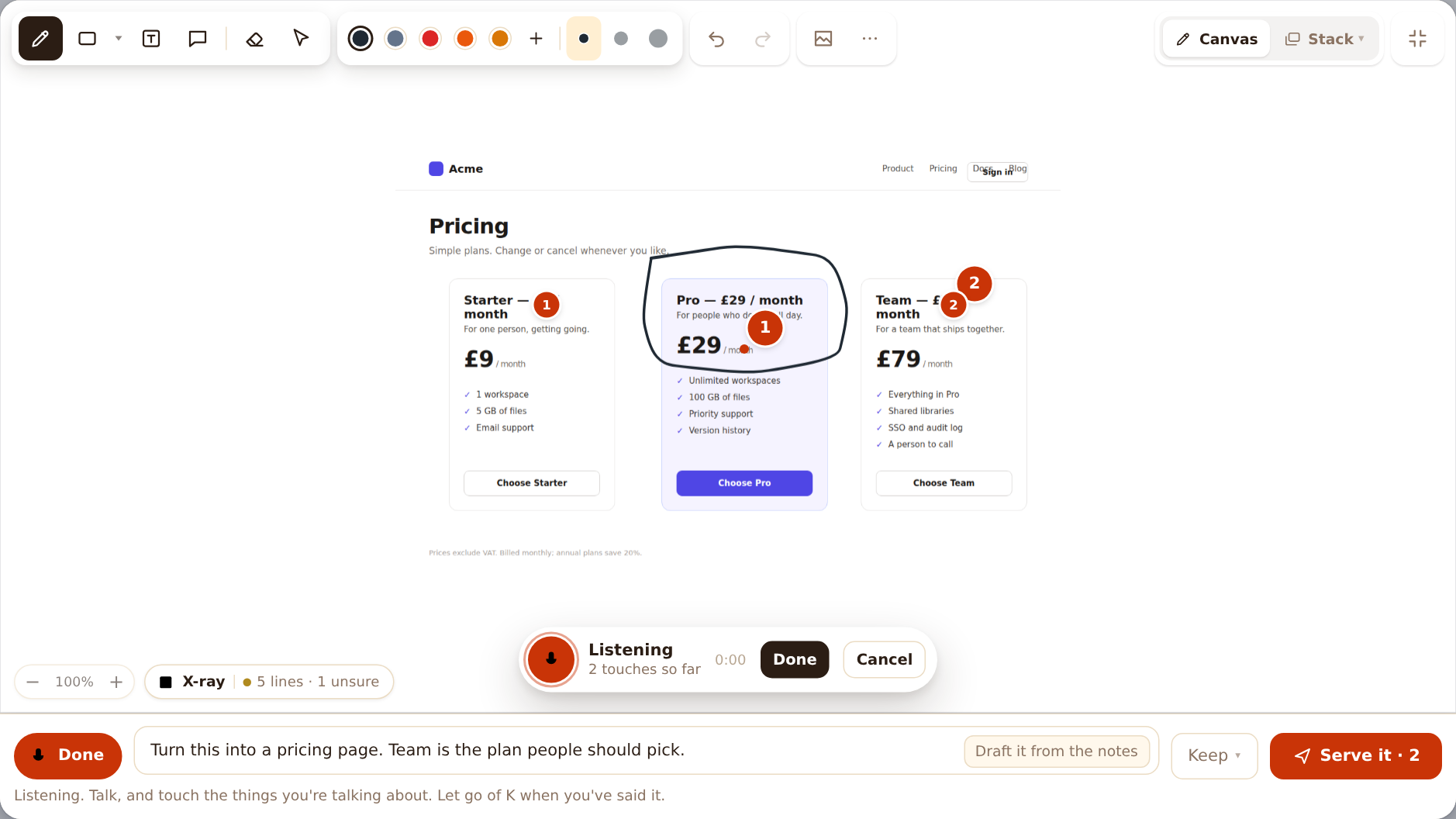
Talk over it
Hold K, say it all in one go, and touch the things you're talking about. Each thing you said becomes a pin on the thing you touched.
An honest brief
Before anything is sent you see the pass: what each note is about, what was read off the picture word for word, and what Preppit guessed rather than knew.
How it goes
Four presses, about a minute
Nothing is sent until you press Serve it and confirm what's on the pass.
-
Press ⌃⇧Space
A frame appears over whatever is under your cursor. Drag it around the part you mean — a slide, a chart, a paragraph, a bit of someone else's website. Or draw from nothing, inside the chat.
-
Draw on it, pin to it
Circle the thing. Cross out the thing. Press and hold to pin a typed comment or record a voice note against that exact spot — transcribed, and you can fix the transcript.
-
Stack them up
Press the hotkey again and the next capture joins the first, in order. Lay the stack out as slides, a storyboard or plain pages, so a deck, a spreadsheet and a web page go across as one prompt.
-
Serve it
Write one line about what you want. Preppit shows you what it's about to send — you confirm, and it lands in the conversation ready to work from.
Talk over it
Say it once, touching the things you mean.
Hold a key, talk the way you'd talk a colleague through it, and touch each thing as you mention it. When you let go, Preppit cuts the recording into notes at the pauses and pins each one to whatever you touched while saying it.
A note said while touching nothing is not guessed at. The pass asks you what it's about, with the nearest things as one-tap answers.
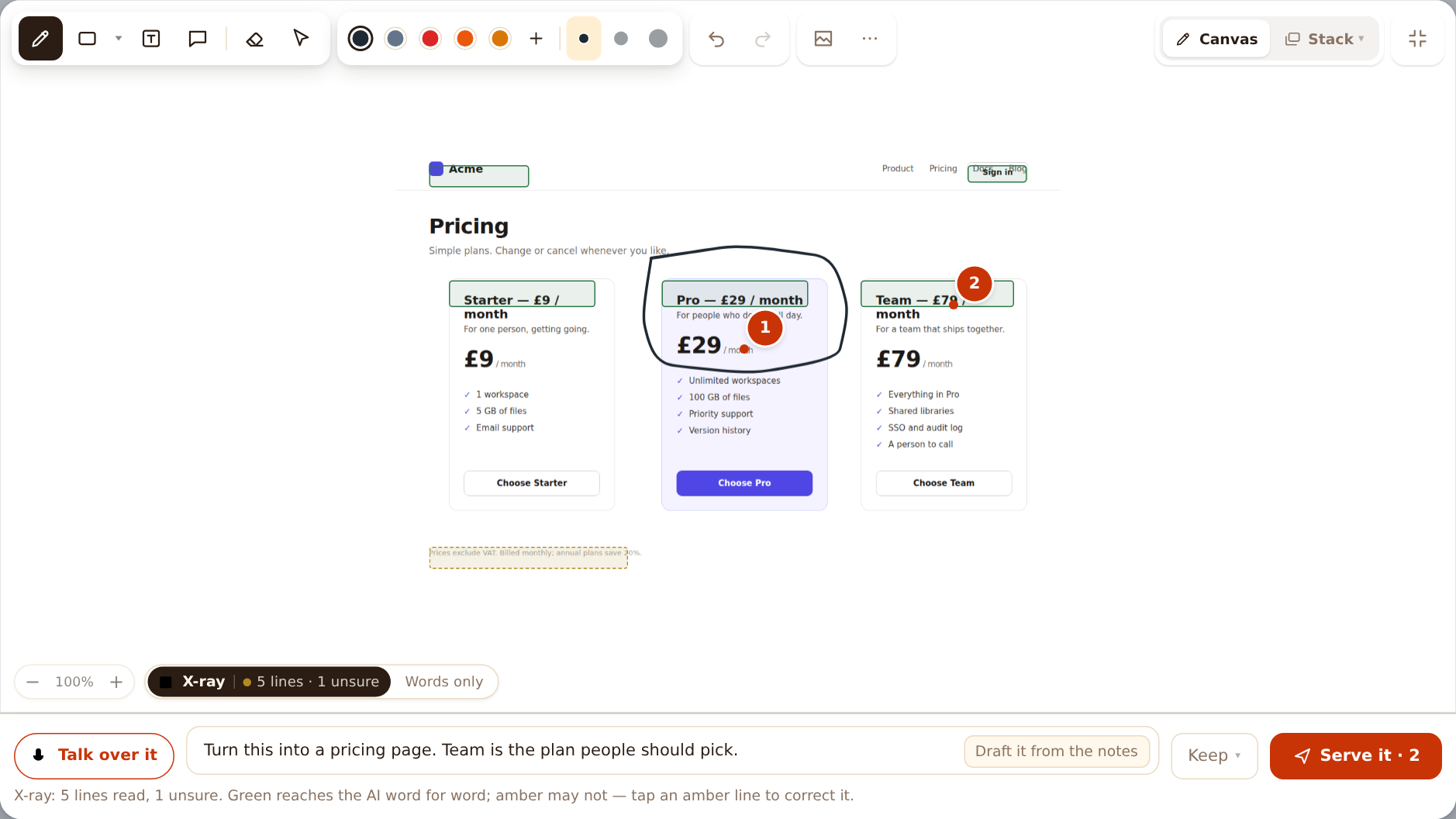
The x-ray
See what the AI will be able to read.
A screenshot is pixels until something reads it. Preppit reads the text off every picture before you send, and the x-ray shows you the result: green where it was sure, amber where it wasn't. Tap an amber line and type what it should say.
Green reaches the AI word for word. Amber may not — which is worth knowing before you send a plan that hangs on a number.
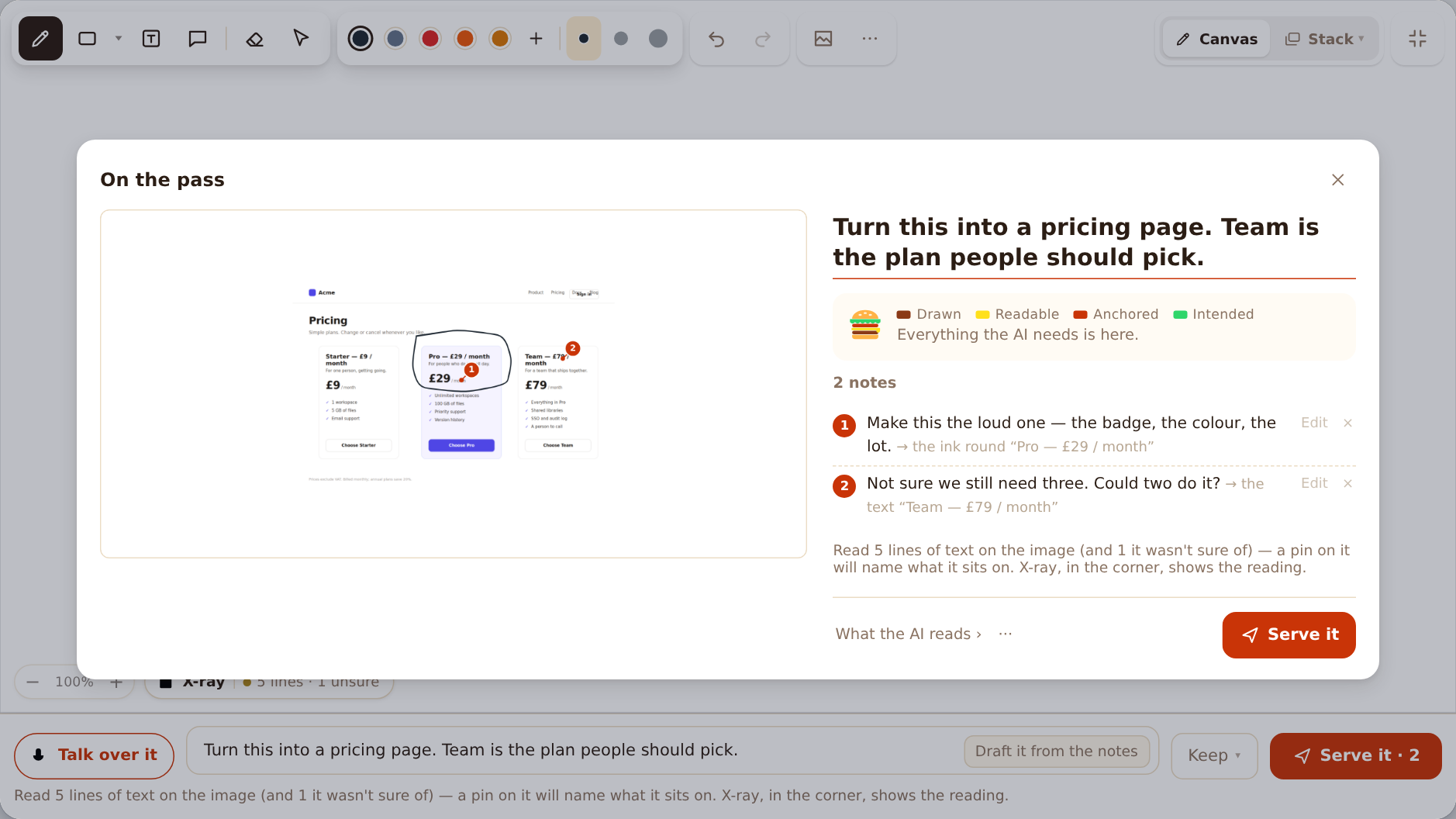
The pass
Nothing leaves without you seeing it.
Serve it opens the pass: your line as the headline, every note with what it's attached to, what was read off the pictures, and anything Preppit needs to ask. Fix a note, answer a question, then serve.
The AI gets a clean picture, a numbered picture, and a brief that says in words what each note is about, in what order, and which parts are certain versus guessed.
A stack
More than one page, in the order you mean.
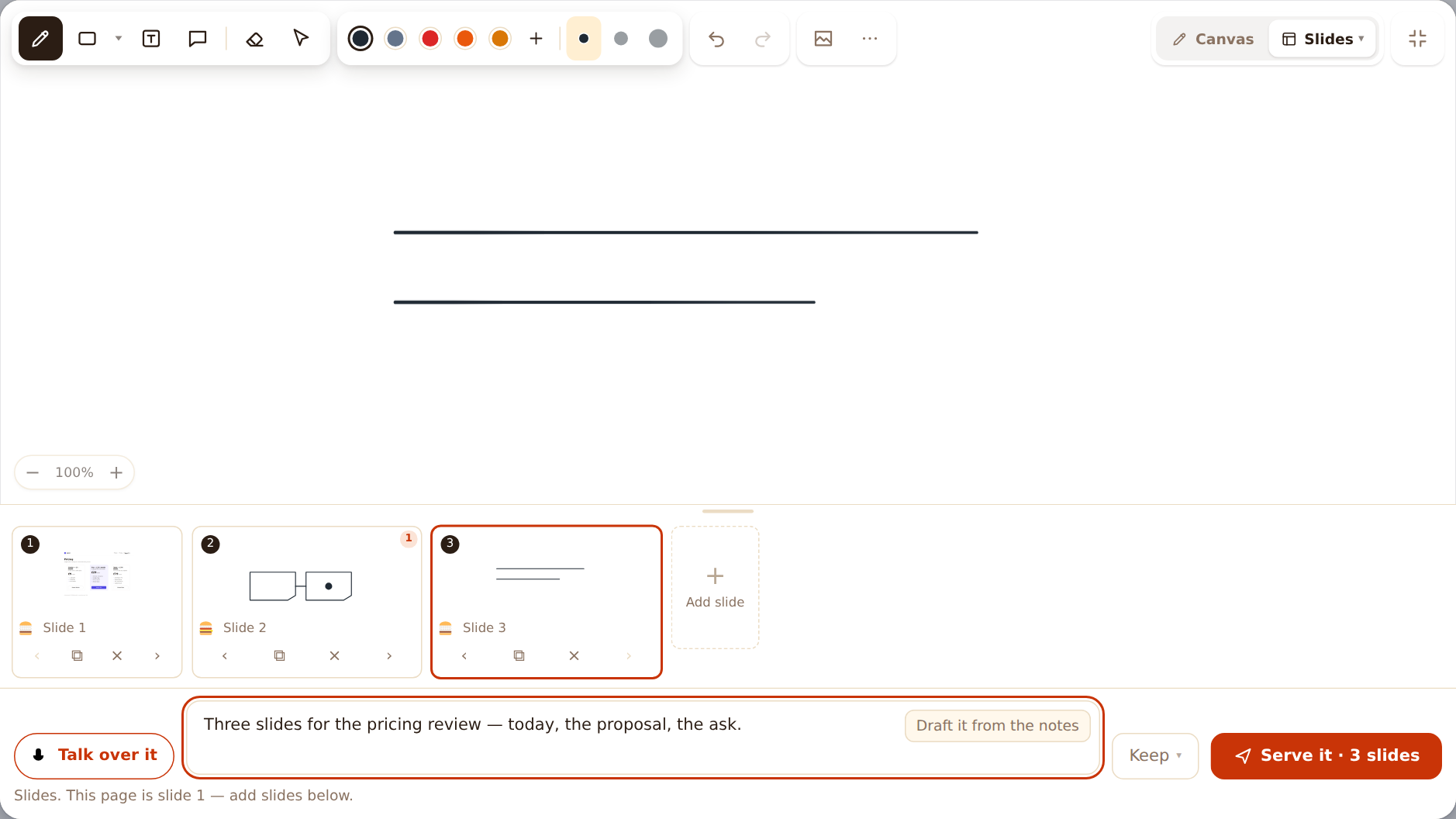
A canvas becomes a stack the moment you add a second page. Lay it out as slides, a storyboard or plain pages; the text boxes read as headings, frames or labels to match. The AI gets a numbered contact sheet for the shape of it and can look at any page at full size.
Why bother
A screenshot flattens what you meant
You can already paste a screenshot into a chat and type three paragraphs underneath it. Everybody does. The trouble is what happens to the relationships between what you drew and what you said.
Screenshot and paragraphs
Your arrows, circles and comments become pixels. The model has to guess which note goes with which thing, from how close they happen to sit. Small handwriting gets compressed. Order and emphasis are inferred, or lost.
A Preppit brief
The picture goes too — but so does a structured account of it: what you drew, what each note refers to, in what order, said in words rather than left in pixels. Where Preppit guessed rather than knew, it says so.
Honest about the claim. That this produces better answers than a screenshot and a good paragraph is the thing being tested, not a thing being asserted. In our own small tests so far, when the notes were pinned the AI worked out what every one of them was about; given the same notes as a list under the same picture, it worked out none. That's one result at a small scale, not a promise — it's why access is limited and why I want to hear what actually happens when you use it.
Setting it up
Three steps
-
Make an account
Email and a password, a link by email, or your Google account. Your work is yours: it isn't shared with anybody else's, and you can take it out or delete it whenever you like.
-
Add the connector to Claude or ChatGPT
Your account page hands you one link per AI. In Claude: Settings → Connectors → Add custom connector, paste it, name it Preppit. Then say open Preppit in any chat and a canvas appears in the conversation.
-
Install the Mac app
It comes with your invitation. Sign in with the same account and it fetches everything else itself. This is the one that gives you the hotkey and the frame over your screen — the connector on its own gives you a canvas inside the chat, which is a good deal less fun.
Opening the Mac app the first time — macOS will say it might be malware. It isn't.
The app isn't signed with an Apple certificate yet — a paperwork and money problem rather than a code one — so macOS blocks it the first time and words that block about as alarmingly as it could. You get past it once, and never see it again.
-
Double-click Preppit, and read the refusal
On macOS Sequoia and later it offers you only Done and Move to Trash. Click Done. Nothing is wrong.
-
Open System Settings → Privacy & Security
Scroll to the bottom of that page. There's a line saying “Preppit” was blocked to protect your Mac, with an Open Anyway button beside it.
-
Open Anyway, then open the app again
You'll be asked for your password or Touch ID, and then it opens. That's the last you'll hear of it.
On macOS Sonoma or earlier, it's simpler: right-click the app in Applications, choose Open, then Open again in the dialog. Apple removed that shortcut in Sequoia.
Or, from the Terminal, on any version — this strips the “downloaded from the internet” mark and the app then opens normally:
xattr -dr com.apple.quarantine /Applications/Preppit.appWhat it needs, and what it sends
The unglamorous part
- A Mac, for the app
- macOS 12 or later, Apple silicon or Intel. The canvas itself runs anywhere Claude or ChatGPT does, including an iPad with a Pencil.
- Screen Recording
- Required for the hotkey — it's how the capture is taken at all. macOS asks you the first time, and only notices you've said yes when the app restarts.
- Microphone
- Only if you record a voice note or talk over a capture, and only asked for at the moment you first do.
- Accessibility
- Optional. Lets Preppit paste into whatever app was in front. Without it, Serve it copies to your clipboard instead.
- Where things go
- Your captures, notes and recordings sit in your own account on the Preppit server. Nothing is sent to an AI until you press Serve it and confirm. Voice notes are transcribed by a speech service; the privacy page names it.
- What travels with a capture
- The picture, your notes, and which app and window it came from — which is useful context and, on a document with a revealing filename, worth a look on the pass before you send.
Where this is up to
Early, and told straight
Preppit works and is used daily by the person who built it. It is not a finished product, and you'd be an early user rather than a customer.
Known and outstanding
- Not signed. Hence the ceremony on first open, above.
- Storage is generous, not infinite. Pictures and voice notes are held in a modest amount of space, and a heavy user could reach the edge of it before there's a proper rule for clearing old ones.
- Apple Pencil works, on one iPad. A 2019 iPad Air with a first-generation Pencil, which is close to the worst case. Newer hardware is untested and should be better, not worse.
- No mobile app. The canvas works in Claude on a tablet; the hotkey and the frame are a Mac thing.
- Your work leaves with you. Export gives you everything as a file; delete removes the lot, including the images and recordings. Both are on your account page.
What I'd like back. Not a bug report. Whether you reached for it a second time, and whether what came back from the AI was closer to what you meant than typing it would have been. That's the whole question.
Show the AI what you really mean.
An account takes a minute. The connector link is on the page that follows, and the Mac app signs in with the same account — it makes its own link, so you never paste one.